Thursday, July 29, 2010

The Weekly Market

A bit primitive, but it works for me.

Every week, rain or shine, holidays or not, there is an open-air market in Uccle on Wednesdays. In theory, it only stretches along one city-block-long median parking, but in fact, cafés and a variety of stores along a three-block stretch of the street take part, along with a good number from the side streets. It's a great business opportunity, and everyone wants to get into the game. Quite aside from the offering of everything from snacks to meats to cheeses to clothes to vegetables, it is one very big happy-hour, as wine booths selling by the glass and bottle are set up to take advantage of the crowds.

Virtually every neighborhood in Brussels has such a market at least once a week. Many of the vendors move their trucks and goods between markets each day and have for generations. When we lived here, our market was on Sunday and, due to its weekend appearance, drew people from miles around. There was very little that you couldn't find at our market, and if it wasn't there it probably wasn't worth having.

Weather is always a factor when outdoors in northern Europe, of course, but Bruxellois are used to rain, so crowds still appear in the most miserable of seasons. But yesterday the weather was incredible: warm, with mostly sunshine, and the market was subsequently packed. If you don't like crowds the market is a place to avoid, but if you're a people-watcher, there is no better opportunity to enjoy the variety of dress and attitudes people put on for public places.

The market is a favorite meeting place for locals and business professionals working in the area. To walk through the wine stalls is to be inundated with a sea of passionate greetings and air-kissing. Every country has its traditional method of greeting friends and relatives; in Belgium, we use three kisses, aimed at the ears from alternating cheeks. (Please; no jokes.) Since you have to do this with everyone you haven't seen since lunch, there is a lot of kissing going on most of the time. Somehow, no one seems to mind.

I bought a glass of white wine from two men selling off a card table. I chose them because: a) they had the biggest crowd, always a good sign of quality product and value for money, and b) they had the cheapest price; an advantage of low overhead, I suppose. Now, here's where buying wine in Belgium makes a difference: the wine and glass was chilled just right, it was served in a clean, proper glass (plastic never touched my lips), and it cost about $3. I could have had the entire bottle for $12.

I had to give the glass back, of course. Each glass is painted on the bottom to identify the seller, necessary because people buy here and wander there; you have no idea where the glass winds up at the end of the day. No one seems to be bothered by this, as drinkers maneuvered for the sunlight or groups of common friends.

I sipped my wine while walking down the aisles formed by the booths and browsed the luscious vegetables laid out to view, the huge cheese selections, the olives, spices, sausages and hams, etc. One large booth specialized in leather watch bands. Puce seemed to be a popular color. The owner seemed happy, but I wondered how many people would search out a watch-band shop at an open-air market; I would think of it more as an impulse sale. Perhaps she was there for the ambiance, the sun and the wine. I know I was.

Wednesday, July 28, 2010

A commercial for Lumix

And now for a short commercial break. After many years of carrying tons of photo equipment over five continents and shooting many thousands of pictures, I finally see the advantages of travelling light. My wife, who has shared the burden, says: "It's about time."

We're on the road this trip for about 120 days and it includes two weddings, big photo events, so I planned on two cameras: the big Nikon with just the minimum zoom lens, flash and required accessories, battery chargers, etc.; and a little Lumix DMC-LX3 plus an external flash. You could put the latter with all its accessories in one pocket; in fact, the external flash is larger than the camera. The Lumix LX3 qualifies as just one step up from a point-and-shoot. After a month of using the Lumix, to my surprise, and quite to the contrary of what I anticipated, the little camera has become my constant companion; the Nikon didn't even make the cut for Europe. I am now a Lumix Lunatic.

There are minuses, of course: there is no eye-level viewfinder and the lens has a limited zoom range. It uses a detachable lens cap and you can't easily mount a protective filter as a replacement. It is slower to start up and focus, the screen washes-out in sunlight and lacks the flexibility and power of the DSLR. As I write this, Lumix has announced a new, improved version, the LX5, to be available in the fall of 2010. It apparently addresses this very list of complaints.

Okay, the LX3 is not a professional camera, but then, so what? I'm taking snapshots for my own enjoyment, not for professional submission. The advantages of packing a light-weight camera with low system complexity and moderate cost, and that interjects fun into picture taking again, far outweighs any concessions required. And I LOVE that fast, wide-angle lens, as I like to shoot natural light and the wide-angle is great for indoor scenes.
The Lumix LX3 is excellent for ambient light, even in dark cathedrals, and its ability to focus under low light conditions is amazing. I have great affection for this camera, and carry it everywhere. One caveat: if you're going to shoot in really dark venues and must use flash, don't rely entirely on the little built-in unit. The camera has an accessory shoe and it allows for more powerful, external flash units. I consider one a good investment.

I'm suggesting that if you like to take pictures while you travel—or at any other time—you should consider the new ranges of smaller cameras, and don't assume that a big DLSR is required for quality shots. My next step will be to the Lumix GF1, slightly larger overall but with a bigger, more sensitive sensor and that accepts interchangeable lenses. It's still small and light, but offers the capability of excellent, high-quality and high-resolution photography at a reasonable cost. From what I've seen of its smaller LX3 cousin, the GF1 with two lenses and an external flash will be virtually all I will need to carry. It even shoots HD video! While the LX3 will come along too, the Nikons are going to get lonesome.

Monday, July 26, 2010

A Spanish Mass

I accompanied N. and her sister, L. to Catholic Mass Sunday morning to view a special ceremony where a young friend and acolyte led the choir and sang. The Mass was in Spanish, and among other things, recognized the national day of Peru (and sang its national anthem!). I haven't lived in a Hispanic country in 34 years, but during that simple, informal Mass, all the warmth, the sense of family, and the delightful and honest humanity of the Hispanics came rushing back to me from those days. It was delightful…and the music was great, too.

The church was in repair; that is, it showed signs of repairs made. Why split hairs? Because little is now happening to finish the works, so the church is covered in primer and spackle. Money is an issue, of course, and many of the churches in Belgium are showing signs of deterioration.

This is not an insignificant building. It is in the middle of Brussels near the Bourse (stock market), an important location as a significant congregation lives nearby. It was built over 100 years ago when it once represented the great wealth and strong religiosity of the Belgians. It is now a bit sad, with its more spectacular features and statutary painted over or simply overlooked. The church's out-buildings, which could easily become valuable housing have been ignored to the point they are thoroughly disreputable.

In a sense, the condition of this church represents the state of the Roman Catholic Church in Belgium, where church attendance has fallen precipitously in the last half of the last century. Only about 7 percent of Belgians now claim to attend church weekly. It was over 60 percent in 1960. The clergy is shrinking, money is in short supply, congregates are getting older and fewer in number, and buildings are slowly decaying.

At the nation's formation the Church was a major land owner, wealthy and influential. In a stupendous land-grab in the 1800's, secular Belgium required the Church to sign over its substantial lands, churches, monasteries and seminaries to the state, and in return, the government promised to pay the priests and maintain the property. There is thus a state entity responsible for church repairs and for paying a stipend to the clergy. There is a process whereby Belgium officially recognizes religious faiths, and new arrivals are now claiming their share of the state's attention—and funding. And, like most government promises everywhere, there has been some hedging and fudging.

This is secular country with a history of strongly Catholic kings and political parties. (King Baudouin abdicated for a day to avoid signing legislation granting limited rights to abortion that conflicted with his strong Catholic faith. The legislation passed in his absence.) However, the Church's influence has been shaken by recent political losses. Public support for the Church has been diluted by damaging, and revisited, charges of molestation and pedophilia, and the State points to the drop-off in attendance to justify the shift in its attention to other budgetary and social issues.

The church Sunday was packed. A parallel was easily drawn to the Roman Catholic Church's strength in Hispanic countries. But, northern Europe has become predominantly humanist and no longer seems to be the Church's stronghold of faith and adherents. That's as it will be, but it's difficult to be ambivalent about the Church's decline when you consider its mixed history and incredible contributions to architecture.

Friday, July 23, 2010

Belgium's National Day

A seriously bad hair day

We returned from Reims early enough to walk to the Sablon district and enjoy some of the celebrations of Belgium's National Day. We're staying with L. just off Avenue Louise, so it's an easy walk to the Place Louise on the old inner wall to connect to any transport, the Toison d'Or for up-market shopping, and, of course, to be intimidated by the Palais d'Justice, the wholly disproportionate center of legal jurisprudence built to put people in their place when faced with the law. I have a hard time deciding whether the building, which is in major renovation, is impressive or simply God-ugly, but either way, it certainly diminishes human scale, a purpose it was, no doubt, intended to serve.

They had closed Blvd Royal to traffic and installed many booths and demonstrations. Most of the stalls were closing and we had to do with one of the last batches of frites, a gaufre (Belgian waffle) and a bottle of orange Fanta, hardly a celebration of Belgium cuisine, but the beer and other stuff was gone. The truth is, other than gaufres, Belgian fries (NOT French at all), beer and sausage, Belgium doesn't do fast food very well in the American sense of the word. This, of course, is a GOOD thing; more on food in future blogs.

The Palais d'Justice is part of the high town of Brussels, built up in the 13th century when residents finally got fed-up with being flooded in the marsh below. We stood on the parapet along the escarpment in front of the building and overlooked much of the city center, from the Atomium near Park Osseghem in the northwest, to the summer carnival installed along the old inner wall road to the south, and to the west as far as the earth's curvature allowed. As night was setting on the city it was an impressive sight.

Brussels was originally built on an island. Centuries later the river was completely covered (it had turned into a sewer and a major health hazard) and the surrounding marsh drained. Now, there is interest in uncovering the river (the sewer problem having been solved in the 20th century) and making it part of the city again. There is already a large canal cutting through the middle, and the city imports many tons of sand to create a "beach" along it for residents.

What drew us downtown was promised fireworks near the Place Royal. It was live-music synchronized to fireworks and, although we didn't get close enough to enjoy the full effect, we did get the tail end of the aerial display as we walked back to Place Louise and the tram. I understand there is a video of the event and we'll watch that. Such is the aging process.

You may have read that Belgium is going through another threatened dissolution of the federal state. The two language communities, French and Flemish (a Dutch dialect), are again at each other over perceived imbalances in financial responsibilities and social consciousness. Like so many political issues, this is a tempest in a teapot serving the interests of a few and benefiting even fewer, based on clawing economic advantage and prestige. There is a lot of simmering antagonism between the two regions that go back a century or more. You could say the French are getting what they deserve for their past arrogance, or the Flemish are selfish, self-important prigs with no sense of community or tolerance. From the turnout at the national celebrations in Brussels, you could also say that most of the people are bemused by the issue and wish the protagonists would move to Poland (It's a joke, Poland). As an English speaker with friends in both camps, I'm in the latter group. And that's all I'm going to say about that.

Brussels is a region in itself, and now probably represents the true Belgian generosity and heritage. In a curious way, it is as cosmopolitan as Jerusalem with an astonishingly diverse population, very high multilingualism and an amazing embrace of cultures, languages, and histories. To walk in its streets and listen to conversations is to be anywhere in the world at a given moment. It is the most livable city I have ever seen, and in modesty, I've seen a lot of cities.

I'm happier with Brussels this visit than I was last year. The city looks cleaner, and less chaotic, although it may have to do with the fact that we're in the holiday season and many Belgians are in France or elsewhere. Nonetheless, I am content.

Thursday, July 22, 2010

In Reins

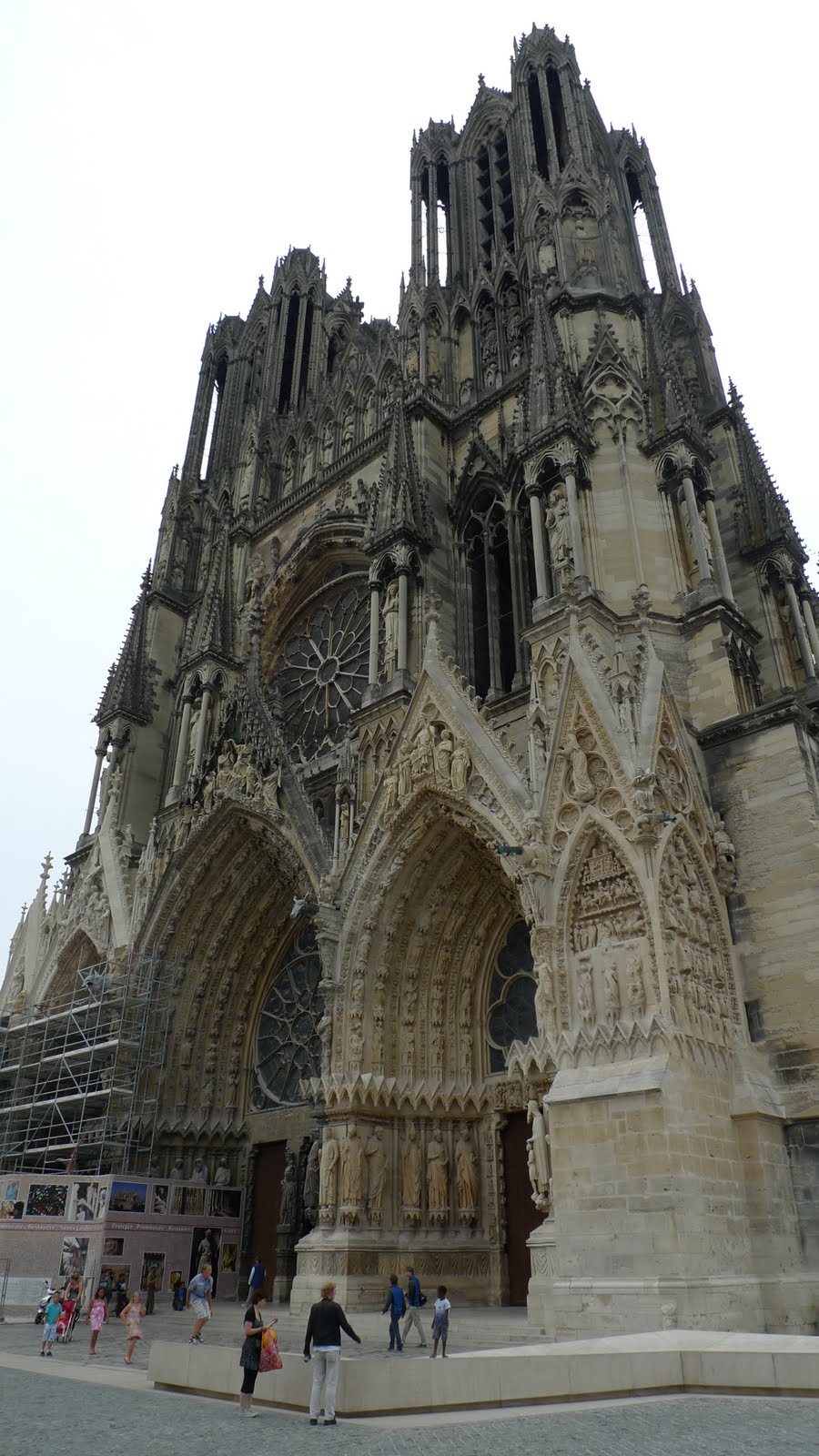
The Cathedral at Reims, France

Yesterday being Belgium's National Day, we decided to do the natural thing and go elsewhere; in our case, to Reins, France, home of, among other things, one of the world's largest medieval cathedrals. An added incentive for the trip was that Reins is sort of the capital of France's champagne region, and there are many caves there that offer tours and FREE SAMPLES.

We decided to approach Reins directly from the north, driving from Brussels through Charleroi and Philippeville, then directly south through parts of the Ardennes forest and subsequent, rolling, French farmland. We hadn't been in this area for over a decade; the last time was to view the August 1999 solar eclipse from within the totality, a vantage point for us just over the French border with Belgium. I remember I got out of bed during a severe illness just to see and photograph the event, and while there was some cloud, we did get a look and pictures of the total eclipse—it engendered a very strange feeling as I recall.

Some things never change, and other than some decline in infrastructure, the Belgium countryside in Wallonia looked much the same as I remembered it: that is, lovely. At this time of the year Belgium is green and lush—so green it almost hurts the eyes. The roads, though, seem to be suffering from a lack of maintenance and investment. I noticed many buildings boarded up and derelict, including at least one beautiful, large house.

We saw quite a bit of the damage from the last massive wind storm just this year. The winds apparently formed vortices that could twist some large trees in two while leaving adjacent stands alone. We drove along through the forest when suddenly, we would come upon a new clearing where the trees were thrown down, twisted and mangled. It reminded us of the storms of 1987 and 1990 when Belgium (and other countries) lost a large percentage of its forests.

We crossed the French border before stopping at a small village, found the town center, and got their last four croissants. Is there anything better than a fresh, French croissant and a cup of strong, French coffee? This is a rhetorical question.

Reims is ungodly flat, good I suppose for its agriculture but a bit boring, otherwise. This is a very old and historic city, however, and it's rich, too. There's a lot of construction going on and the architecture is interesting and worth the extra effort and time to view. I suggest lunch at the town center, although avoid the outside tables and eat inside; they are repaving the streets and walks. It will be beautiful when they finish; until then, it's noisy and dusty.

But the reason we were there was to see the Cathedral of Reims, which fairly reeks with history and culture, and is of an impressive size. This building has been around, in some form or the other since the 400's, and has been significant in the anointing of European kings and such for over a thousand years. The existing structure, although damaged in WWI and WWII (and numerous other wars), has been rebuilt into essentially the same edifice that stood here 800 years ago. I may have a few dates wrong, but if you're that picky, or want to know more about Reims (and you should) go to Wikipedia. For sure, it is one impressive cathedral and a must on your list of things to visit in northern Europe. The stained-glass windows are fantastic (the Chagall windows are particularly famous) and the scale of the structure is just stupendous.

They are busy cleaning the accumulated soot of centuries and renovating statues, etc. It is a huge job and about a third done, using my estimate. There are some snaps published for my followers and distribution list, but for some various perspectives on the cathedral and Reims, go to http://Picasa.com and search the public photo archives for Reims Cathedral. There are some really great photos. Bookmark this site for future use. If you want to be added to my distribution, add a comment below with your email address.

A note on French drivers: avoid angering them. They can harbor the worst cases of road rage in Europe, and can be outright dangerous to themselves and others. No joke; they can act as insane, behave irrationally, and use their vehicles as a weapon. If approached or threatened, act toward them as you would a rabid monkey and avoid any eye contact.

Monday, July 19, 2010

A Fashion Statement

I can't resist an opportunity to prove that I am still "with it" and "have it", by identifying important trends that will help those on-the-hop to remain hip. I have picked up on two style trends that will, no doubt, make it across the water to the USA shortly and become adolescent icons. On the other hand, I could be entirely wrong, but then, that's fashion for you.

I first noticed these trends in Italy and have now confirmed their presence in Belgium. Italy as a style-setter speaks for itself, but for these trends to penetrate to Brussels, which has the style-consciousness of a post-war Soviet archipelago, they must have strong mojo indeed.

The first trend is the growing popularity of digital watches. Not the desperate compromises where a tiny digital read-out hides behind an analog face; I'm talking 70's and 80's digital dot-matrix with plastic bands and indecipherable digits, just as we once cherished. Again, we can count on time being measured to the tenth of a second, an accuracy that escapes analog hands that only vaguely point somewhere. Of course, the watches are still set to what we think is the current time, but with digital, we can once again be certain in our ambiguity.

Secondly, gone are the small ear-buds that used to indicate a person had escaped reality and was deep into a musical nirvana created by their MP3 player. Apparently they let too much noise escape the ear and failed to render the advocate completely deaf. The ear-buds are now being replaced by gigantic earphones, the more exotic and grand the better. They lend the wearer a certain alien look from the rear, which we can only assume is intended, but they must enhance the musical experience. On the plus side you no longer have to share the musical tastes of the enthusiast when you share a common space; on the down side you have to look twice to see if they really are listening to music or can be confirmed as from an alien planet. The odds are about even.

In Bergamo

Looking up at the High City

Perched at the edge of the foothills of the Italian Alps is the small city of Bergamo. It calls itself an "Alpine Village", but this is mostly hype; while it's very pleasant, and a portion of the city is elevated somewhat, it is certainly not alpine by most definitions of the word. It IS charming, however, and we enjoyed our entry into Europe by spending a couple of days in one of our favorite places in the world: Italy.

We surprised ourselves by avoiding car rentals and taxis, walking wherever we wanted to go. After five years in the U.S. it was nice to discover we still had legs. Unfortunately, it was hot as hell both days we were resident, so walking wasn't all it should be, but we stuck to our guns, so to speak. Our hotel was close to the airport, but the newer—and lower—part of Bergamo was an easy stroll away. Be prepared to walk through some of the industrial district to get there.

One of the things we noticed right away is the number of immigrants. Italy is full of them as it's a favorite country of entry into the EU. The good news is that they all eventually migrate to the UK. (Just kidding, UK.) They are easily profiled as they don't look at all Italian and are thus not entirely welcomed by residents, who, like residents everywhere, suspect recent arrivals of loose morals and contributing to the crime rate, taking away jobs, etc. I will say, however, that the level of tolerance is higher in Europe toward just about everything than in the U.S.

You have noted by now that there are two Bergamos, with the older, walled city looking down on the newer part. Essentially, as it is in so many cities, the higher you go the fancier things get. There are funicular rails that at nominal cost will lift you up the escarpment into the old city, although there is a bus route as well for those wanting to keep their wheels on the ground. Movie buffs will observe that a scene from an award-winning foreign film Il Postino (foreign to the U.S., at any rate) was shot at one of the Funicular stations in the old city, where we enjoyed a delightful chilled wine and snacks for a ridiculously inexpensive 11 euro. Now that I mention it, we found the city to be very inexpensive, especially considering the quality you enjoy.

Italy is unchanging; it still offers the best food in the world, bar none. This is obviously an opinion, but it's my blog, so there. After five years in the U.S. we had forgotten what pasta was supposed to taste like; how wine can illuminate your spirit without clogging the senses, or how good, professional service can make you welcome instead of pushing you aside to make room for another seating. We ate fresher vegetables prepared just-so, cheeses that were to die for, breads that fully qualified to be so called, and fruit that actually tasted like it was supposed to. Did I mention the ice cream? Honest-to-Pete, if Americans had any taste buds left they would have rioted against their food industries and preparers generations ago for the sacrilege they commit.

We're going back to the region before leaving Europe this summer and are looking forward to spending more time in the surrounding mountains; at the lakes (Como is near, among others), and in some of Italy's great cities (Bergamo is 45 km from Milano). The only downside to northern Italy is that the English, whom, despite their peculiar affinity for the bizarre and their propensity toward weird, manufactured foods, have recognized a good thing when they see it and have now occupied much of Tuscany. (Well, wouldn't you?). Fortunately, they tend to clump together, so they can be avoided. (Just kidding, UK.)